Is the U.S. becoming like Germany in the 1930s?

“Was Germany in the 1930s anything like the US now?” I get asked that a lot, not because I was there but because my parents were, and my father left behind plenty of papers and correspondence for me to study – which I did recently, along with deep dives into the history of that era.
Basic answer: Yes, there are similarities between then and now, as well as many differences, the most important being that the US has a lot more going for it – historically, culturally, and politically – than Germany in the 1930s.
For one thing, Germany had only fifteen years of experience with democracy from the time it established the Weimar Republic in 1918 until 1933, whereas the US has had almost 250 years of experience with democracy, however clumsy or imperfect it may often seem. When Germany first adopted a constitutional government it was at a dark time in their nation’s history – a defeated emperor with a defeated army, a wrecked economy, and a dispirited population. The first thing Hitler did when he became dictator was to abolish the constitution and the institutions of democratic governance.
For another, German culture embraced authority, especially hierarchical, entitled, and militaristic authority, and had so for centuries, taking it to higher levels than any other nation in modern history. Americans from the beginning distrusted authority, disrespected it, disobeyed it, thumbed their noses at it while carrying flags saying, “Don’t tread on me,” and crossed the forbidding Appalachians to settle lands beyond the reach of The Law. In America, defiance of authority is a way of life, and outlaws are national heroes.
America’s strengths have always been our basic rights and freedoms, as guaranteed in the Constitution and its twenty-seven amendments. This is the foundation that makes our country exceptional – and great. This is the self-proclaimed land of the free and the home of the brave, working “to secure the blessings of liberty to ourselves and our posterity.”
Among these are the Bill of Rights, the first ten amendments to the Constitution that secured freedom of religion, speech, and the press; rights of assembly and petition; the right to bear arms; security against unreasonable searches and seizures; rights in criminal cases, civil cases, and rights to fair trial; as well as the rights guaranteed by the 14th, 15th, and 16th amendments and others that came later. Germany had nothing like that in the 1930s, and Hitler did nothing to encourage it.
However, there’s no doubt that our rights and freedoms are under threat in the US in 2026 in ways never before experienced in this country. In his classic The Rise and Fall of the Third Reich, William L. Shirer recounted the three major principles that guided Hitler’s journey from convicted and jailed traitor to the top job in less than ten years.
Propaganda. Rhetoric based in grievance, lies, bogus theories of history that demonize Others and glorify racial superiority, seeking retribution, creating crises to assert leadership, smugly luxuriating in violence. “Germany has lost its greatness (losing the First World War), and someone must be blamed. We’re better than everyone and deserve more, so we’ll take it. Democracy is for losers.”
Organizational control. On no one’s authority but his own, Hitler rewrote the whole structure of the nation’s governance, put himself at the top, and ruled through coercion. With only one legal party, elections were unnecessary. By placing himself above (rather than alongside) the legislative and judicial systems, he controlled everything: the media, the military, the church, the arts, the professions, the schools, the libraries, and proclamations of what’s true and what’s not. Skullduggery and strong-arming the country’s aging and weary leadership allowed him the final ascent to the top. The legislature, forcibly deprived of a few rival voters, assented, reducing itself to an advisory role.
Bullying and terror. Behind closed doors Hitler threatened those who disagreed with him. He created his own paramilitary police force (the “stormtroopers” or “brownshirts”), notorious for its brutality accosting people on the street, beating people, disappearing people, separating families, relocating people to camps for “re-education,” and later, escorting them to their death. He militarized the entire nation, sending them to conquer and occupy the entire continent. He and those he commanded were responsible for the deaths of tens of millions.
Many Americans recognize these principles at work even now. And in Minneapolis, where I live, we’re seeing and experiencing them up close, in more advanced stages. Many fear we’re seeing a trial run of more enlarged efforts to reach for more and more control of a free state by a ruthless central government.
If the United States is to survive as a nation still living, cherishing and defending its original ideals, we must protect our rights and freedoms – protecting them from elimination by arbitrary and vengeful politicians, because if lost they’re gone. That’s what happened in Hitler’s Germany.
Former President Clinton told us, on an anniversary of the nation’s birthday, “There’s nothing wrong with America that can’t be fixed with what’s right about America.” We must protect our democracy from those who would corrupt it – with liberty and justice for all. We must use our constitutional and legal rights and freedoms or we’ll lose them.
Use them how? Advocacy and support for organizations and institutions vital for maintaining democracy, such as the ones Hitler destroyed. Advocacy and support for organizations that strengthen our people and cultures at the community level, through housing, safe food and water, creative expression and truth-telling, education and skill development that allow people the prospect of upward mobility. Advocacy and support for organizations that provide emergency food, safety, and shelter from the storm, and that try to address the gaps created by inadequate public policy or private practice.
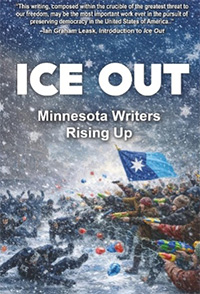
ICE OUT: Minnesota Writers Rising Up is a powerful anthology of poetry and prose responding to the presence of U.S. Immigration and Customs Enforcement (ICE) in Minnesota—and to the human cost of policies that blur the line between law enforcement and occupation. Published in collaboration between Afton Press and Calumet Editions, ICE OUT is both a work of literature and an act of resistance. It speaks to readers concerned with immigration justice, civil liberties, contemporary American politics, and the enduring role of writers in times of crisis. This book is for readers who believe that words still matter—and that bearing witness is a form of action.